Platform
The hardware is ordinary.
cato8 OS is not.
Anyone can put fast silicon in a small box, and several companies do. The reason local AI fails is almost never the hardware: it is drivers, quantisation formats, inference servers and the weekend they consume. The operating system is the actual product.
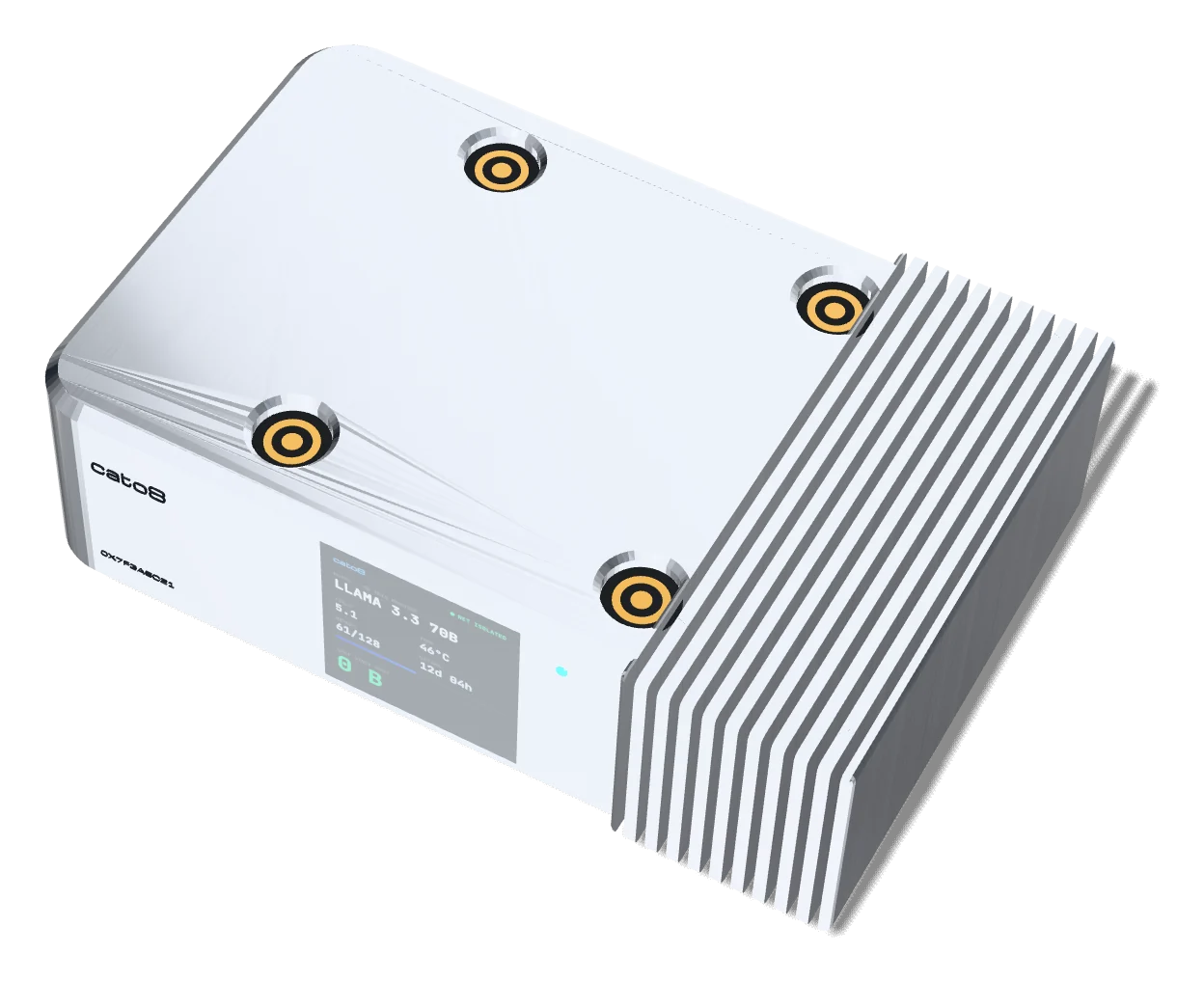
Models arrive installed
Weights are on the drive when it ships. First boot to first answer is about ninety seconds, with no download, no account and no terminal.
One place for everything
Swap models, add a pack, connect a folder, update the system. No config files, no package manager, no quantisation formats to understand.
Built to be left alone
Signed updates, an immutable system partition, sensible defaults. It is an appliance and it behaves like one.
Nothing phones home
No licence check, no telemetry on what you ask, no account required to use the machine. Turn the network off and it carries on.
What runs on it
Open models, chosen and tested for you
The hardest part of running AI locally is not installing it, it is deciding which of the hundreds of available models to use for what. AI Packs are that decision, made and tested, then configured on your machine. When something genuinely better arrives, the pack updates.
See the packsIsolation
The switch is part of the system, not a sticker
There is a physical switch on the back that disconnects the network. cato8 OS is built so that everything keeps working with it off: the models are local, the interface is local, and there is no call waiting to be made. That is what makes the claim demonstrable rather than contractual, and it is why regulated organisations can use it at all.
Enterprise controlsIt comes on every machine.
cato8 OS is not sold separately and there is no subscription. It is installed, configured and updated as part of the deployment by a SetupMyAI engineer.